
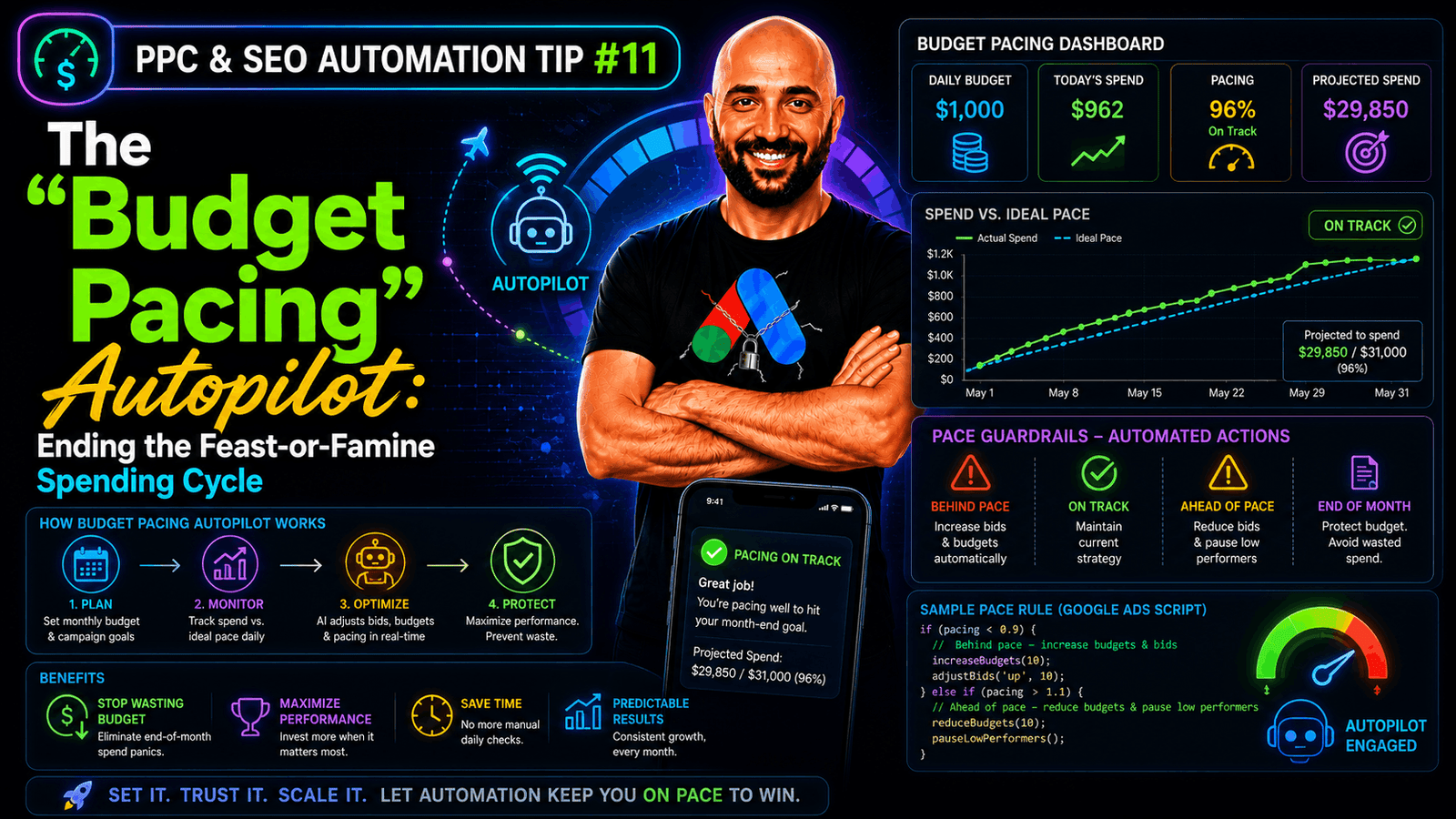
Picture two equally damaging disasters that happen in ad accounts every single month. In the first, a campaign gets overexcited mid-month, spends aggressively, and burns through its entire monthly budget by the 20th — leaving you dark and invisible for the ten most important days. It’s one of the recurring pacing problems our team at PPC & SEO Automation Lab fixes with automation. In the second, a campaign is too timid, under-paces all month, and on the 31st you discover you’ve spent only 60% of the campaign budget — leaving a third of your firepower (and your results) on the table. Both are failures of pacing, and both are completely preventable with automation.
Manual budget pacing is a nightmare of mental math and error-prone manual checks: dividing monthly budgets by days remaining, checking spend-to-date across a dozen campaigns, and adjusting daily caps — every single morning. It’s tedious, error-prone, and the first thing to get skipped on a busy day. So it gets skipped, and the feast-or-famine cycle continues.
A Budget Pacing Script turns this into a self-correcting autopilot.
How the Budget Pacing Autopilot Corrects Itself Daily
- The Target: Feed the script each campaign’s monthly budget, on a schedule similar to how a bulk campaign scheduler handles recurring, rules-based adjustments. Every morning it calculates the ideal spend-to-date based on the day of the month (factoring in your day-of-week performance curves, not just a flat line).
- The Comparison: It compares actual spend-to-date against the ideal pace, the same way you’d track campaign performance over time to catch drift early.
- The Correction: If a campaign is overspending, the script trims the daily budget to stretch it to month-end. If it’s underspending, it raises the daily budget to recapture lost ground — and Slacks you a summary of every adjustment it made.
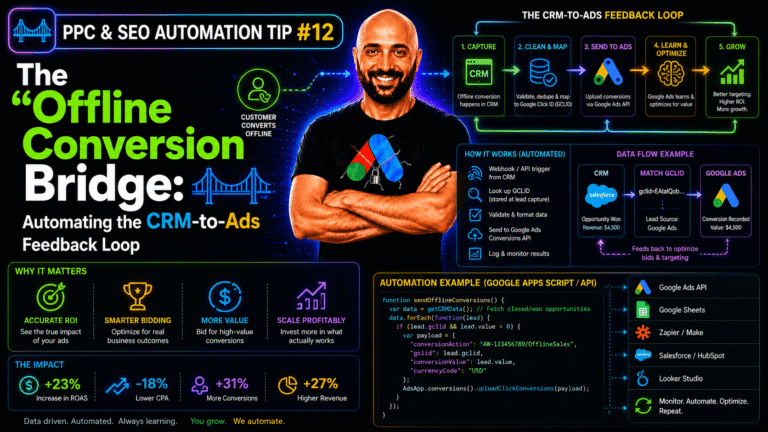
You wake up to an account that has already corrected its own course overnight. No more burning out by the 20th, no more leaving money unspent on the 31st. Set the monthly target, let the code hold the throttle, and pace every dollar to land exactly where it should. Once your budget pacing is on autopilot, the next leak worth closing is what happens after the click — covered in the Offline Conversion Bridge.
The Real Cost of Poor Budget Pacing
A campaign that burns its entire monthly budget by the 20th goes completely dark for the remaining third of the month — meaning zero visibility, zero clicks, and zero conversions during whatever days happen to fall in that gap, regardless of how valuable they are. On the flip side, a campaign that under-paces and leaves 40% of its budget unspent by the 31st has simply left that money on the table, along with all the conversions it could have driven. Either failure mode can cost an account a third or more of its monthly potential, for reasons that have nothing to do with strategy or creative quality.
Common Mistakes When Automating Budget Pacing
- Using a flat daily target: Dividing the monthly budget evenly by days ignores real day-of-week performance curves — weekends or weekdays often convert very differently, and a flat pace ignores that.
- Correcting too aggressively: Large daily budget swings in response to a single day’s variance can cause the algorithm’s own learning phase to reset; smoother, gradual corrections tend to perform better.
- Not accounting for known spend spikes: Planned promotions, holidays, or sales events should be factored into the ideal pace calculation, not treated as an anomaly to correct against.
Frequently Asked Questions
What is budget pacing in Google Ads?
It’s the practice of spending a campaign’s monthly budget evenly and intentionally across the month, rather than burning through it too fast early on or leaving a large portion unspent by month’s end.
How does a budget pacing script decide how much to adjust daily budgets?
It compares actual spend-to-date against an ideal spend-to-date calculated from the day of the month and historical day-of-week performance patterns, then nudges the daily budget up or down to close that gap.
Can budget pacing automation replace strategic budget planning?
No — it handles the day-to-day execution of hitting a target you’ve already set. The strategic decision of how much to allocate to each campaign in the first place still needs a human call.
#ppc_seo_automation_tips






Leave a Reply